

National nonprofit Per Scholas helps Detroiters find jobs in IT with no-cost training programs
National nonprofit Per Scholas helps Detroiters find jobs in IT with no-cost training programs
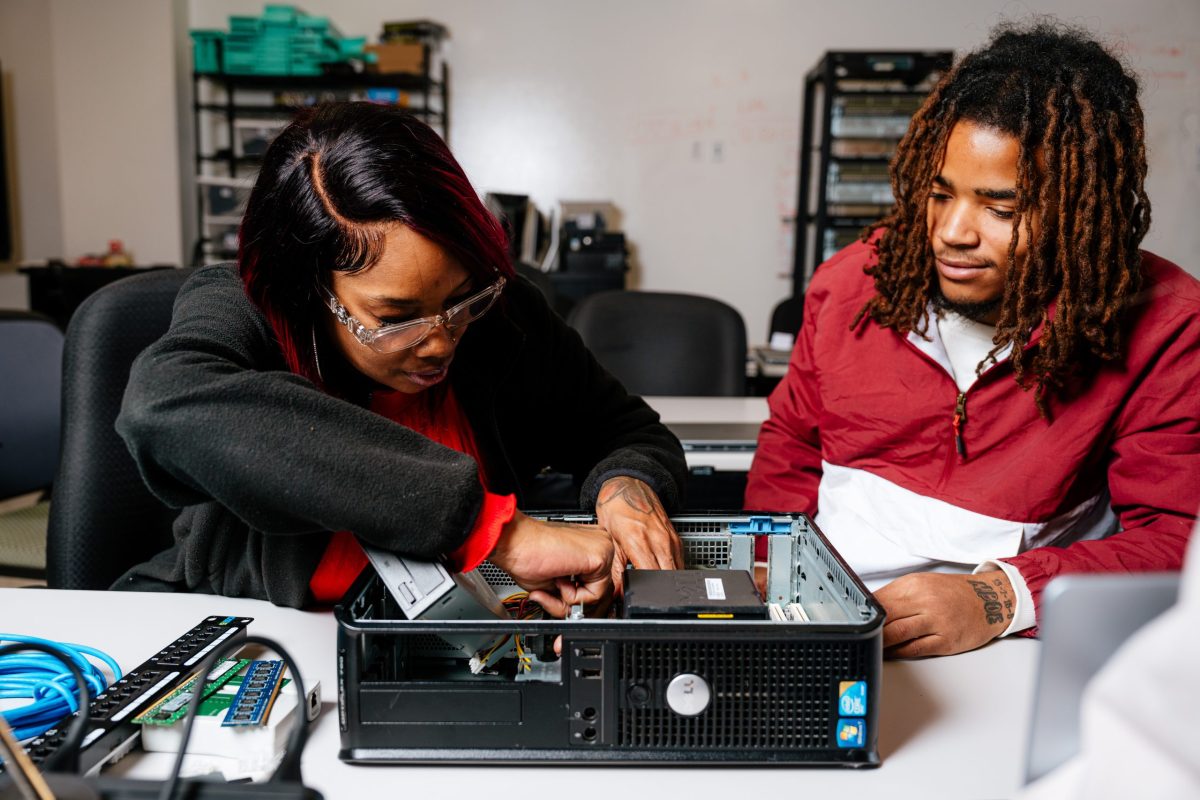
Per Scholas Detroit, offers no-cost training, certification, and career coaching for technology-related fields like systems support, cybersecurity, and data engineering.
By Randiah Camille Green
January 21, 2026
This sponsored story was originally published by Outlier Media
This sponsored story was written by Randiah Camille Green and created in partnership with the Ralph C. Wilson, Jr. Foundation. It is part of a year-long series focusing on programs and pathways to good paying jobs and careers in Detroit.
Despite her years of experience working in technology roles, Tracy Maricle could not find a job. She had just moved back to metro Detroit in 2025, after completing a contract in Dallas, and it felt like she couldn’t land an interview, no matter how many jobs she applied for.
“In the IT industry, as it has developed, companies are looking for people who are [both] certified and have hands-on experience,” she said. Though she had the work experience, she lacked many of the certifications that companies were requiring.
So Maricle enrolled at Per Scholas Detroit, which offers no-cost training, certification, and career coaching for technology-related fields like systems support, cybersecurity, and data engineering. The program offers two tracks each year with a remote option and a hybrid option that includes both in-person and online classes. The 12-week courses consist of three eight-hour days onsite and two remote days of learning each week.
Lots of industries are looking for employees to fill technology roles that Per Scholas trains for such as banks needing cybersecurity officers.

“Healthcare is another one. There’s a lot of demand in Corewell Health and we’re right near the Henry Ford Hospital as well,” said Per Scholas Detroit Managing Director Laura Chavez. “They’re always looking to upskill their employees, so we offer them the skills that they need to be the resume or applicant that stands out among others.”
The courses offered are adjusted yearly based on industry demands and evolving standards. For example, all courses will expand to 15 weeks to include an AI training component beginning in 2026.
“That was something that all employers said that they wanted,” Chavez said about the addition of AI training. “We’re always trying to assess what is important and what employees are looking for. So our tracks change based on the demand in your area… We’re always in the field talking to employees, talking to our partners, trying to see what the best fit would be for the next year.”
The program attracts a variety of learners from people who are completely new to the IT field to those who want to further their career like Maricle.
“We have a lot of veterans, retirees, and stay-at-home parents who are re-entering the workforce,” Chavez said. “It’s a lot of work, so they have to be committed to the program, but we commit to helping them with finding jobs.”
Upon completing the Per Scholas course in July of 2025, Maricle received certifications in CompTIA A+, Google IT, and ServiceNow, to help better her chances at landing a job. She now works as an instructional assistant for Per Scholas Detroit.
“When I heard there was an opening, I thought, maybe I can set up the next round of learners for success and help put more qualified, certified techs out into the job world,” Maricle said of her choice to work at the Detroit office of the national Per Scholas nonprofit skills training organization.
Per Scholas graduates have landed IT jobs at General Motors, Corewell Health, Henry Ford Hospital, Blue Cross Blue Shield and more. The IT service company HumanIT also partners with Per Scholas to place their graduates in jobs. In one cohort earlier this year, Chavez said, 75% of the students had secured a job prior to graduation.
“One of the essential things Per Scholas does for its learners is professional development,” Maricle said. “There were things that were covered that I hadn’t thought of [including] ways to rewrite my resume to make it pass all of those AI bots that are filtering resumes, that hadn’t been in place the last time I was looking for a job.”
Since completing the program and now working for Per Scholas, Maricle has received several job offers from recruiters. But, she says, she is happy to stay where she is, helping the learners who complete the program get high-quality jobs.
“Because of what Per Scholas does, I am able to forward those recruiters on to our learners, once they become alumni, to secure employment. It’s really a full circle experience,” she said.
According to Chavez, Per Scholas looks to place their graduates in jobs that offer at least $24 an hour, with medical benefits, paid time off, and vacation time.
“We are extremely appreciative for the funding we have received from Ralph C. Wilson, Jr. Foundation because this is creating legacy and generational wealth in the city of Detroit,” she said. “A lot of them go from a regular nine-to-five low-paying job, or multiple jobs to make ends meet, and they can now go into a long-lasting career. The impact is not just an individual, it’s the family of the individual.”
Now located in the New Center section of midtown, in the Fisher building, Chavez says she hopes Per Scholas can one day establish another office in Southwest Detroit.
Nationally, Per Scholas celebrated its 30-year anniversary in 2025. The organization, which serves 24 cities, has operated in Detroit since 2018. Anyone living in Southeast Michigan who has earned a high school diploma or GED equivalent, and who meets income requirements based on their household size, can apply to Per Scholas for hands-on, no-cost IT training.

For more information or to apply, visit perscholas.org/locations/detroit.
The best places to go in the US in 2026
CATTalyst COllective Is Launched to Boost Local Businesses
‘There’s a tremendous need’: New study finds WNY students lack access to after-school programs
From GEDs to good jobs: Detroit program helps young adults build their futures
From GEDs to good jobs: Detroit program helps young adults build their futures
SER Metro received a $500,000 grant from the Ralph C. Wilson, Jr. Foundation in 2021 for YouthBuild, construction trade program.
By Randiah Camille Green
December 5, 2025
This sponsored story was originally published by Outlier Media

This sponsored story was written by Randiah Camille Green and created in partnership with the Ralph C. Wilson, Jr. Foundation. It is part of a year-long series focusing on programs and pathways to good paying jobs and careers in Detroit.
Many youth in Detroit struggle with keeping a job, not because they can’t do the work, but because of access barriers. Those who are single parents may have trouble finding daycare. Those without a car have to depend on unreliable transportation. They may lack the financial literacy skills to know how to maintain a budget. The nonprofit SER Metro Detroit is working to holistically address these issues by giving youth the skills needed to secure and retain employment.
SER Metro, which stands for service, employment and redevelopment, offers a GED program called YouthBuild. It provides people from 18 to 24 years of age the opportunity to pursue a career in construction or health care while earning their GED. The program is 240 hours and can take between eight weeks and seven months to complete.
“We have infrastructure and systems that don’t allow people to be successful if they don’t have many of the boxes already checked,” said SER Metro Assistant Vice President Ann Leen. “The baseline of who we are is about lifting people out of the cycle of poverty. Our focus is not just employment, but education and access to long-term sustained employment.”

Beyond increasing chances for employment, SER Metro’s YouthBuild program teaches interpersonal assets such as leadership skills and how to be a team player, which Vocational Construction Instructor Mark Garner said are important to keeping a job.
“It’s instilling in them showing up to work every day, on time, with the right attitude, regardless of what’s going on at home,” Garner said.
Garner has worked in construction since 2006 and is a journeyman carpenter by trade. He has been a SER Metro YouthBuild instructor for three years.
“A lot of youth get a job in construction but they don’t keep the job, and one of the main reasons is they haven’t learned how to stay off their phone,” he said, emphasizing that soft skills are just as important as knowing how to do the job. “Even their posture, the way they walk in the door can dictate whether a journey person is going to be comfortable working with them everyday. I make sure that they are aware of those things.”
SER Metro received a $500,000 grant from the Ralph C. Wilson, Jr. Foundation in 2021 to build a lab for the construction trade program. YouthBuild students on the construction track gain carpentry experience, explore 22 different trades, receive Occupational Safety and Health Administration (OSHA) 10 and OSHA 30 certification, CPR/First Aid certification, and EPA lead renovation, repair, and painting certification, alongside hands-on experience.
The program runs on a multi-craft core curriculum set forth by the National Association of Building Trades to introduce prospective candidates to the construction trade and help them make an educated decision about what path is best for them. The curriculum covers a full range of subjects, including an introduction to the industry, green construction, blueprint reading, sexual harassment in the workplace, financial literacy, and workplace diversity.
Twenty-one-year-old Julian Zuniga-Lopez got his GED through SER Metro and completed the construction trade program in 2024. During his 10th grade year of high school, the COVID-19 pandemic caused his school to shift to online learning, which was challenging for him.
“I couldn’t really focus,” he remembered. “I didn’t really like doing school online, so I basically dropped out and started working.”
Inspired by his father, who works in construction, Zuniga-Lopez decided to do the GED and construction program to give himself a chance for a better future. He said SER Metro’s instructors made the math portion of the GED test so easy to understand that he felt like he “learned four years of math in one week.”
“I have a master’s degree and I have to tell you that I attempted to take the GED in the last two years and I failed it,” Leen said. “Generally speaking, it’s around an 11th grade reading level and 11th grade math. … In many cases, especially for our young adults and teenagers, they are reading at about a fourth grade level and their math is about a second grade level. So we do a lot of tutoring, upskilling, and foundation work.”
After completing YouthBuild, Zuniga-Lopez was able to enroll in Union Carpentry School, a four-year apprenticeship program. Though he is currently working in landscaping, he hopes to eventually finish the apprenticeship. He praises Garner for being a solid mentor.

“He was such a good teacher who motivated you and pushed you to do better,” he said of Garner. “For the carpentry school, he helped me with my interview to get in there. Apart from that, he was a really good mentor as well. I would talk to him about things I was going through and I felt really comfortable with him.”
Gardener emphasized the importance of instilling confidence in young people who may not have had the most positive reinforcement when it comes to learning.
“I had one student who came through, and his self-esteem was low because of his upbringing and what he’s lived through. He struggled reading a tape measure and didn’t think he could do it because he’s no good at math. So, I let him know, it’s not necessarily that you’re no good at math, it may just not have been presented to you correctly,” Garner said. “His experience was, if he messed up, somebody would call him stupid or dumb, so he came to believe that. But I have shortcuts I teach to help the students deal with fractions, and once we got over that hurdle and got his confidence up, his entire stature began to change.”
SER Metro also helped Zuniga-Lopez get his driving permit. As he did not have transportation, they provided him with $1,000 of free Ubers to get back and forth to the program, and paid for his driving lessons and exam.
“We like to pride ourselves on meeting people where they are,” Leen said. “We sometimes do community programming—meeting people at libraries, meeting people at community centers… If they don’t have transportation, or [car] insurance, or child care, this is the deck of cards we’re playing with. So how can we figure out how to get you a car [and] how to get you a good paying job that supports your insurance and child care needs. There are lots of ways to find solutions for individuals who have already had systems fail them.”
For people considering the YouthBuild program, Zuniga-Lopez said, “If they don’t think school is for them, honestly, give it a try. It’s so much different than going to regular school because they help you one-on-one and really explain things. It’s a good opportunity if people need help, because they help you out with pretty much anything you need to better your future.”
SER Metro’s main office is in Southwest Detroit. They also have a location on Detroit’s eastside and several satellites across the city, including in the Northwest Activity Center. For more information, see sermetro.org/